Grave Lack of Discretion of Judgment in Marriage
By Rev. Fr. Michael C. Chime, JCD
You can recite everything the Church teaches about marriage and still not have given the consent that makes one.
I have watched it happen from the tribunal bench for twenty years. A person answers every question correctly: permanence, fidelity, openness to children, and yet the choice they made on their wedding day was not the mature, free act the Church requires.
A grave lack of discretion or judgment is the canonical name for that failure. It is one of the most common grounds a tribunal examines in a marriage annulment, and one of the most misunderstood.
This is not about whether a marriage was hard, or whether it ended. It is about something narrower and more serious: whether, at the moment of consent, a person could weigh what they were choosing and choose it freely.
What is a grave lack of Discretion of Judgment?
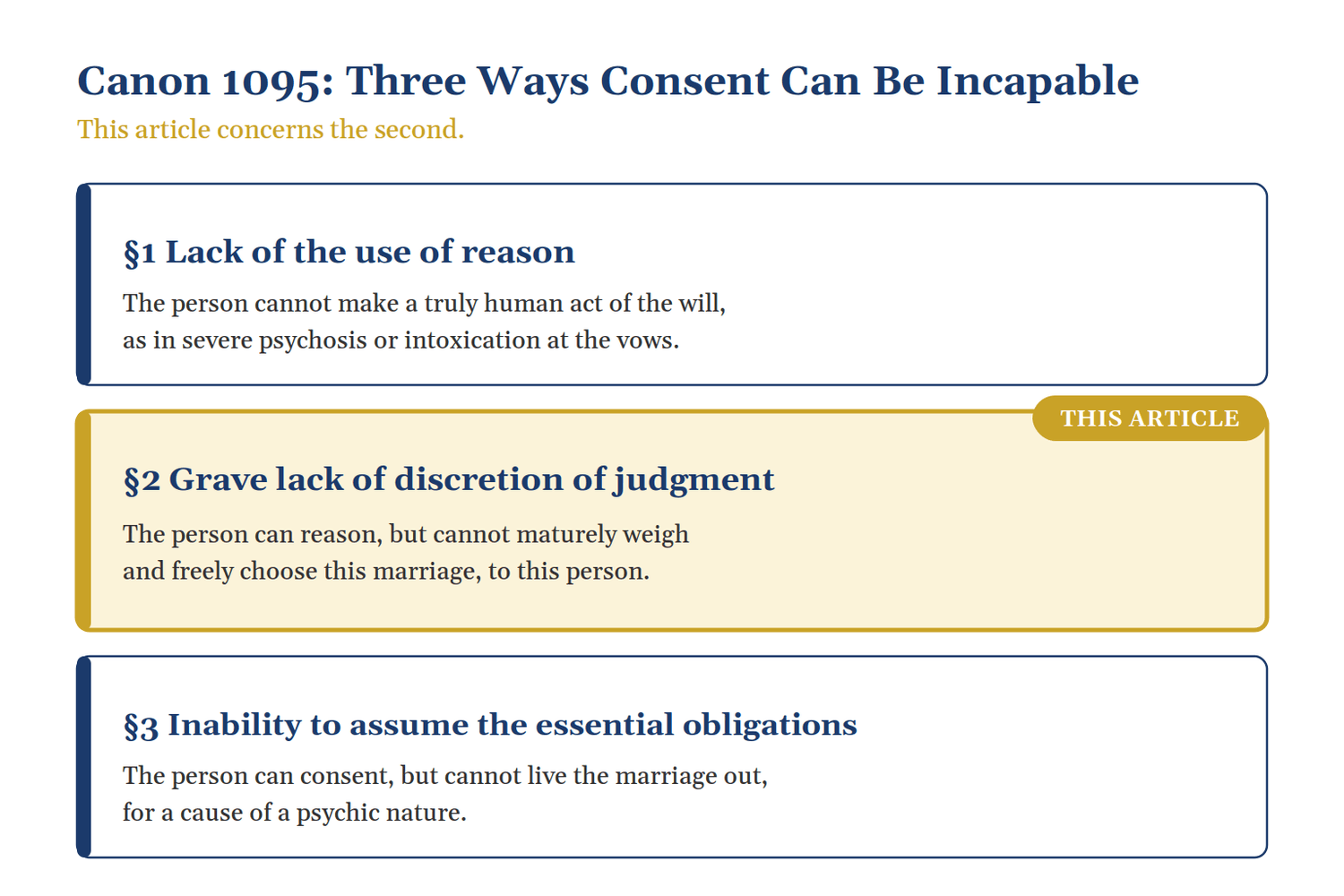
A grave lack of discretion or judgment means that, at the moment of consent, a person lacked the mature judgment needed to evaluate and freely choose this marriage, to this person (canon 1095 §2).
The Church does not ask for a perfect decision. It asks for a proportionate one, a judgment serious enough to match the gravity of marriage.
The canon speaks of the essential matrimonial rights and duties. To consent with discretion, a person must be able to grasp not just the words of those duties but their weight, and to choose them with a will that is genuinely free.
Canon lawyers describe discretion in three parts: an adequate knowledge of oneself and the other person, a real weighing of what marriage will ask over a lifetime, and the free choice to enter it.
When one of these is gravely disturbed at the time of the vows, the consent is not the consent the Church constitutes.
Notice the words "at the moment of consent." The tribunal does not ask whether the marriage later became difficult. It asks what a person was capable of on the day they married.
Knowing About Marriage Is Not the Same as Grasping It
Canon 1096 sets a very low floor of knowledge, and discretion asks for something far above it. The floor requires only that a person not be ignorant that marriage is a permanent partnership between a man and a woman, ordered to children through some form of bodily union.
That knowledge is presumed in anyone past adole-scence, and almost everyone clears it.
Discretion is the step above the floor. This is where I speak of two kinds of understanding. There is notional understanding, the knowledge you can recite, the definitions and the doctrines and the right answers.
Then there is operative understanding, the grasp that actually governs your decisions when the choice costs you something.
A person can hold the first in full and lack the second entirely. It is the same distinction I draw under the first pillar of valid consent, clarity.
I remember a man who could have taught the marriage preparation class himself. He knew that the bond cannot be dissolved, that fidelity is total, that a marriage open to children is not optional.
He had all of it, word for word. What he had never done was let any of it reach the level where it shaped what he actually chose. His knowledge sat in his memory. It never became the thing he was deciding with.
Clearing the floor of knowledge is not the same as having the discretion to consent. A person can satisfy canon 1096 completely and still fail canon 1095 §2, because the first asks what you know and the second asks whether you could truly weigh it and choose it.
How the Church Tells Discretion Apart from Immaturity
The Church draws a hard line here, and it protects marriages more than it dissolves them: only incapacity invalidates consent, not mere difficulty.
Pope John Paul II made this explicit in his 1987 address to the Roman Rota. A person who found marriage hard, who was immature, who made a poor choice, has not by that fact shown a grave lack of discretion.
Difficulty in living a marriage is not the same as an incapacity to consent to one.
This is the distinction I see missed most often, in both directions. Some people assume that because their marriage failed, their consent must have been defective. That does not follow.
Others cannot imagine that a sincere church wedding could have rested on consent that was never sound. That does not follow either.
| Difficulty (the marriage remains presumed valid) | Incapacity (consent may be defective) |
|---|---|
| Married young and found the first years hard. | So immature at the time that no real weighing of the choice was possible. |
| Chose a spouse family had warned against, and it failed. | A grave defect meant the person could not evaluate the choice at all. |
| Felt the ordinary nerves and rush of a planned wedding. | A crisis so consuming that the decision was never truly deliberated. |
| Regrets the marriage now that it has ended. | Evidence shows the capacity for a mature, free choice was absent on the wedding day. |
The threshold is gravity. Ordinary immaturity, nerves, youth, the pressure of a wedding already planned- these are common, and on their own they do not reach the standard.
What reaches it is a defect serious enough that the person could not, at that time, make the mature and free judgment marriage requires.
Proving that usually calls for more than an account of a troubled marriage. It ordinarily calls for evidence about the person's state at the time of consent.
What Grave Lack of Discretion Looks Like From the Bench
The clearest way to understand this ground is to see it rather than define it. Here are two patterns I have seen many times, drawn together into composite cases rather than any one person's story.
A young woman marries in the middle of a crisis she cannot see past. A pregnancy, a family in turmoil, a fear of being alone; the marriage is less a choice than an exit.
She knows what marriage is. She can say the words. But the weighing of the choice never happened, because everything in her was bent on escaping the present.
Years later, when the pressure is gone, she can barely recognise the decision as hers.
A man marries because the wedding has taken on a life of its own. The hall is booked, the families are invested, the date is set, and somewhere along the way the question of whether he should marry this person stopped being a live one.
He did not weigh it. He was carried by it. On the day, he consented to something he had never actually evaluated.
Neither of these is a story about a marriage that got hard. Both are about a judgment that was never fully made.
That is the heart of grave lack of discretion of judgment, not a marriage that failed, but a consent that, examined honestly, was never whole.
How a Tribunal Weighs This Ground
A tribunal begins by presuming the marriage is valid, and the burden falls on the person who claims otherwise (canon 1060).
This presumption is not a formality. It means the tribunal does not go looking for reasons to nullify a marriage.
It looks for whether the evidence is strong enough to overturn a standing assumption that the marriage was real.
A person raises this ground by petitioning for a declaration of nullity, the process most people call an annulment.
To find grave lack of discretion, the tribunal must be satisfied of three things: that the defect concerned the essential rights and duties of marriage, that it was truly grave rather than ordinary weakness, and that it existed at the moment of consent rather than developing later.
Because the question is about a person's interior state on a past day, the evidence is careful and often slow. Testimony from both parties and from witnesses matters.
In grave cases, a psychological assessment is ordinarily part of the record, though the judgment itself belongs to the tribunal and not to the expert.
The expert describes the person's condition. The judge decides what it means in law.
The Catechism states the principle plainly: consent must be a free act of the will, and a marriage entered without that freedom is invalid (Catechism 1628 to 1629).
The tribunal's whole task is to discover, with moral certainty, whether that freedom and that judgment were present when the vows were spoken.
If You Are Asking This About Your Own Marriage
If you are reading this because you are wondering about your own marriage, begin where the Church begins: your marriage is presumed valid. Wondering is not a verdict.
A difficult marriage, even a failed one, is not evidence of defective consent, and no article can tell you whether your consent was sound. That judgment belongs to a tribunal, and it is made carefully, with real evidence, not from a distance.
What you can do is bring the question to someone who can help you carry it. Your priest can talk with you honestly about what you are noticing.
If there is something to examine, he can point you toward the tribunal, whose work is not to end marriages but to find the truth about them.
Whatever you are holding, you do not have to sort it alone, and you do not have to reach a conclusion today.
Conclusion
If you take one thing from this, take the difference between knowing what marriage is and being able to choose it.
Canon 1096 asks the first question and sets a low bar. Canon 1095 §2 asks the second and sets a serious one.
Grave lack of discretion of judgment is the name for consent that cleared the first and never reached the second, not a marriage that turned hard, but a choice that was never fully made.
If these questions are alive for you, the honest next step is a conversation, not a conclusion. Bring them to your priest.
And if it would help to sort out what you are actually asking before that conversation, our marriage readiness examination can give you the questions worth bringing.
To see where this ground sits within the whole of matrimonial consent, read the five pillars of valid consent.
My forthcoming book takes you inside the questions a marriage tribunal asks about consent, so the line between knowing what marriage is and truly choosing it becomes one you can see for yourself. Be the first to know when it is released.
Notify Me When the Book Is OutFrequently Asked Questions
What is grave lack of discretion of judgment in simple terms?
It means that when a person married, they lacked the mature judgment needed to weigh and freely choose that marriage (canon 1095 §2).
They may have known what marriage is and still been unable, at that moment, to truly evaluate the decision and elect it freely.
It is judged at the time of consent, not by how the marriage turned out.
Can a Catholic marriage be annulled for immaturity?
Only if the immaturity was grave enough to prevent a mature, free judgment at the time of consent.
Ordinary immaturity, youth, or nerves do not meet the standard, because the Church holds that difficulty is not the same as incapacity.
A tribunal looks for a defect serious enough that genuine discretion was absent when the vows were spoken.
What is the difference between lack of discretion and inability to assume the obligations of marriage?
Lack of discretion concerns the judgment a person could make at the moment of consent, while inability to assume the obligations concerns whether they could live the marriage out afterward.
These are separate grounds in canon law, examined and proven separately. A person might have consented with full discretion and still, for reasons present from the start, have been unable to carry the obligations.
Does grave lack of discretion have to be proven by a psychologist?
In grave cases it ordinarily involves a psychological assessment, though the judgment itself belongs to the tribunal and not to the expert.
The court weighs the assessment alongside the testimony of the parties and witnesses. The expert describes the person's condition, and the judge decides its meaning in law.
Is grave lack of discretion the same as regretting the marriage later?
No. Regret, hindsight, or a failed marriage are not evidence that consent was defective. A grave lack of discretion concerns whether the capacity for a mature, free choice was absent at the moment of consent, which is a different question from how a person feels about the marriage now.
Related reading: What Is an Annulment? The Five Pillars of Valid Consent.
Lorem ipsum dolor sit amet, consectetur adipisicing elit. Autem dolore, alias, numquam enim ab voluptate id quam harum ducimus cupiditate similique quisquam et deserunt, recusandae.