Five Pillars of Consent in Catholic Marriage: Theology of Marriage and the Sacramental Marriage Covenant
By Rev. Fr. Michael C. Chime, JCD
Quick Answer: The Catholic Church teaches that consent, not the ceremony, makes a marriage valid. For that consent to be sound, it must be clear, free, capable, intentional, and unified.
These five pillars, drawn from the Code of Canon Law, determine whether your sacramental marriage is valid from the moment you speak your vows.
A wedding can look flawless and still bring no marriage into being if the consent underneath was missing something the Church requires.
Key Takeaways:
Consent, not the wedding ceremony, creates the marriage bond (Canon 1057)
A marriage can look perfect and still be invalid if consent was defective
The five pillars are Clarity, Freedom, Capacity, Intention, and Unity
Each pillar maps to a specific canon that marriage tribunals apply
Canonical form (an authorised minister and two witnesses) and freedom from impediments are also required
Pre-Cana prepares you for married life but does not canonically examine your consent
Deliberate exclusion of children, permanence, or fidelity invalidates consent
Civil marriage and sacramental marriage are not the same thing
Convalidation is available for couples who married outside the Church
Examining your consent four to five months before the wedding is ideal
A woman I will call Ada sat across my desk eight years into a marriage the Church had never recognised. She had spoken her vows clearly. The priest had witnessed them. The register was signed.
None of it mattered, because the consent underneath those vows had been missing something the Catholic Church requires for a valid marriage.
In two decades on the marriage tribunal, I have seen this pattern more times than I can count. Most failed Catholic marriages do not collapse because love ran out. They collapse because something was never sound in the consent that created them, and nobody checked beforehand.
The five pillars of consent in Catholic marriage are the framework I wish every couple had before the wedding, though the answers can still change.
They come from the canons that tribunals across the universal Church apply. They ask one question five ways: was the consent genuinely given?
What Does the Catholic Church Require for Valid Marriage Consent?
The Catholic Church requires three things for a valid marriage: sound consent, proper canonical form, and freedom from impediments. Consent is the heart of the three, because it is consent that actually creates the marriage (Canon 1057).
The priest does not marry you. You and your spouse marry each other. He stands as the Church's witness and makes sure the conditions are met.
Catholic theology understands matrimonial consent as the act of the will by which a man and a woman irrevocably give and accept each other to establish a marriage (Canon 1057).
This is not a feeling or a renewable agreement. It is a single, unconditional act. The Church presumes a marriage to be valid unless the contrary is proven, because marriage enjoys the favour of the law (Canon 1060).
However, the Church also recognises that consent can be defective in ways that mean no marriage ever came into being.
Does the Catholic Church recognise marriages without full consent? No. Consent given without the minimum understanding of what marriage is, or given under force and fear, or given by someone who lacks the psychological capacity to assume marital obligations, is not the consent the Church constitutes.
A wedding can follow every rubric perfectly and still produce no valid marriage if the consent underneath was defective.
This is what a marriage tribunal examines when a person petitions for a declaration of nullity, commonly called an annulment. The tribunal does not ask whether the wedding was celebrated correctly. It asks whether genuine consent was given.
That distinction matters, because it means the validity of your marriage was determined at the moment of consent, not by the quality of the ceremony around it.
What Makes a Catholic Marriage Sacramental? The Sacrament of Marriage and Matrimony Explained
A Catholic marriage becomes sacramental when two baptised persons validly exchange consent. Between the baptised, a valid marriage is always a sacrament; there is no valid marriage between two Christians that is not also sacramental (Canon 1055).
The priest does not confer the sacrament of matrimony. The spouses confer it on each other through their consent. This is why the Church teaches that the ministers of the sacrament are the spouses themselves. The priest's role is to witness, bless, and register the marriage on behalf of the Church.
What is the difference between civil marriage and sacramental marriage? A civil marriage is a legal contract recognised by the state, dissolvable by civil divorce. A sacramental marriage is a covenant bond that the Church teaches is indissoluble, meaning that no human power can dissolve it once it is validly entered into.
The state recognises the civil effects of a Catholic marriage. The Church recognises the sacramental bond, which endures beyond civil divorce.
Can Catholics marry outside the Church and have it be sacramental? Generally, no. The Church requires canonical form, meaning the marriage must be celebrated before an authorised priest or deacon and two witnesses.
If a Catholic marries outside this form, without a dispensation, the marriage is not recognised as valid by the Church. The couple would need to pursue convalidation, a process that addresses the defect and renews their consent to make the marriage valid.
There is more to know here. A marriage between a Catholic and a baptised non-Catholic is a mixed marriage, which requires the permission of the local ordinary (Canon 1124).
Canonical form is still required, although the ordinary can dispense from it for a grave reason, allowing the marriage to be celebrated in another Christian church while remaining recognised by the Catholic Church (Canon 1127).
A marriage between a Catholic and a non-baptised person faces the impediment of disparity of cult, which requires a dispensation for the marriage to be valid at all (Canon 1086). Without the required permission or dispensation, the marriage is not valid in the eyes of the Church.
How Does the Catholic Church Define Conjugal Consent in Marriage?
Conjugal consent in Catholic marriage is the mutual, irrevocable act of the will by which a man and a woman give and accept each other to establish a permanent, faithful, and procreative partnership (Canon 1057).
The word "conjugal" points to the totality of the union: body, mind, and will. It is not merely an agreement to live together or an emotional commitment.
It is a covenant that orders the whole of two lives toward the good of the spouses and the procreation and education of children.
What role does conjugal love play in Catholic marriage theology? Conjugal love is the love that animates the covenant.
The Second Vatican Council, in Gaudium et Spes, described it as a love that is fully human, faithful, and fruitful, springing from the spouses' will and embracing the good of the whole person.
Conjugal love is not the same as consent, but it is the context in which consent is given. When that love is genuine, it supports the consent. When it is reduced to sentiment alone, it can mask a consent that is missing something essential.
The Church distinguishes between the affective dimension of love and the volitive dimension of consent. You can feel deeply in love and still not consent to what the Church constitutes as marriage.
You can also consent validly while your emotions are mixed, because consent is an act of the will, not a feeling. This distinction matters when couples assume that strong feelings guarantee a valid marriage. They do not.
What guarantees validity is a consent that is clear, free, capable, intentional, and unified.
What Are the Five Pillars of Consent in Marriage?
The five pillars of consent in Catholic marriage are Clarity, Freedom, Capacity, Intention, and Unity. Each maps to a specific canon in the Church's Code of Canon Law.
Together, they ask whether the consent you give on your wedding day is the consent the Church requires to bring a valid marriage into being.
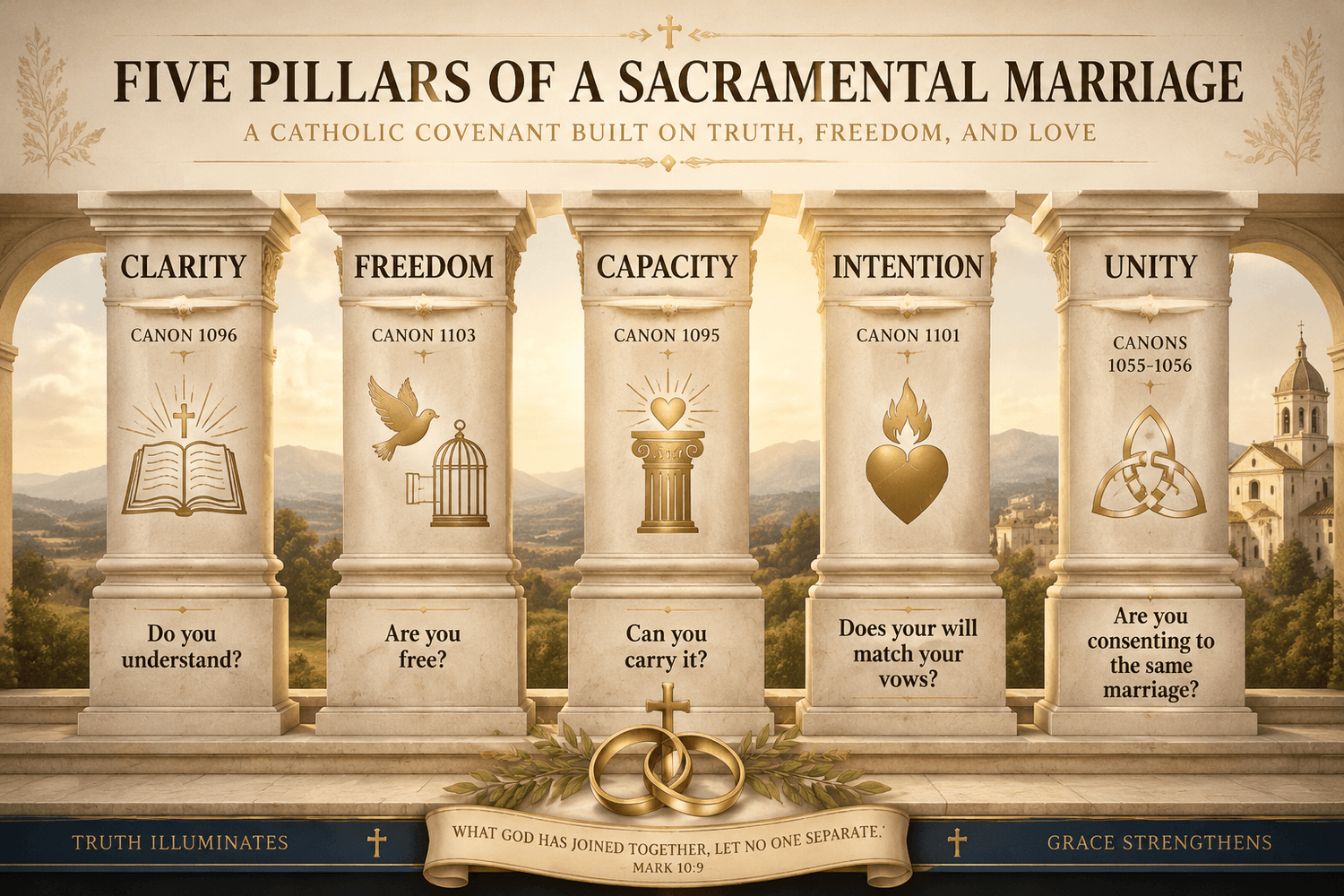
Pillar One: Clarity (Canon 1096)
Clarity asks whether you actually understand what you are consenting to. The Church sets a minimum: to consent to marriage, you must at least know that it is a permanent partnership between a man and a woman, ordered to the procreation of children through some form of sexual cooperation (Canon 1096). Reciting that sentence is not the same as living from it.
A man once sat across from me who could answer every question about Church teaching correctly. Permanence means until death. The bond cannot be dissolved. He had it all, word for word.
However, his marriage had not survived, because his working understanding, the one that shaped his decisions, had never matched the answers he could recite.
Knowledge of doctrine is not the same as operative understanding—the first you carry in memory. The second governs what you do when marriage costs you something.
Pillar Two: Freedom (Canon 1103)
Freedom asks whether you are genuinely able to say no. Consent extracted by force or by grave fear, even fear that comes from outside the relationship, is not valid (Canon 1103). This is not about a threat of violence at the altar. It is about whether refusal was ever a real option.
One woman's case stays with me. Her family had arranged her marriage with what everyone experienced as care. Each step was handled for her. By the time she reached the wedding, refusing would have meant unravelling something her entire family had built around her.
The pressure was never named as pressure. That is exactly what made it work. Ordinary nerves are not coercion. The question is sharper: could you have said "not yet, or not this person," and remained yourself?
Pillar Three: Capacity (Canon 1095)
Capacity asks whether you can actually carry what marriage requires, at this point in your life. The Church recognises that a person can sincerely want to marry and still lack the internal capacity to assume its obligations (Canon 1095). Wanting is not the same as being able.
One of the most intelligent men I have ever examined moved through marriage preparation flawlessly. When the marriage demanded real sacrifice, the capacity to weigh that cost and commit to carrying it had never formed in him.
Intelligence is not the evaluative capacity the Church means. They are easy to confuse, and they are not the same. Capacity is often a question of "not yet" rather than "never."
You can love someone deeply and still not be able to carry the commitment right now.
Pillar Four: Intention (Canon 1101)
Intention asks whether your inner will matches the vows you speak. The Church presumes they are the same, and that presumption protects you (Canon 1101 §1).
However, if a person, by a deliberate act of the will, excludes an essential element or property of marriage, its permanence, its faithfulness, or its openness to children, the consent given is not the consent the Church constitutes (Canon 1101 §2). Canon lawyers call this simulatio, simulation.
A woman I will call Juliana spoke her vows, carrying a private reservation she had never told anyone about. She had conditions she intended to revisit once circumstances changed.
The words she spoke at the altar were unconditional. Her will was not. The most dangerous reservations are the ones you have never said out loud, because silence lets them feel reasonable.
Pillar Five: Unity and the Marriage Sacrament (Canons 1055 and 1056)
Unity asks whether the two of you are consenting to the same marriage. The Church defines marriage by its essential properties, unity and indissolubility (Canon 1056), and by its essential ends, the good of the spouses and the procreation and upbringing of children (Canon 1055).
When two people's understandings diverge at that level, their consents only look identical from the outside.
Picture two sincere Catholics. One understands marriage as a covenant between two individuals before God. The other understands it as the union of two families, with the couple serving them.
Both are reverent. Neither has tested the assumption against the other. The divergence remains invisible until the marriage is under pressure, and then the two different marriages they each consented to begin to pull in different directions.
What Invalidates Consent in a Catholic Marriage?
Consent is invalidated when one or more of the five pillars is defective. The most common grounds for a declaration of nullity map directly onto the canons behind these pillars: an incapacity to assume marital obligations (Canon 1095), a failure of minimum understanding (Canon 1096), force or grave fear (Canon 1103), or the deliberate exclusion of an essential element (Canon 1101).
Can you get married in the Catholic Church without sacramental intent? If both parties are baptised, the Church teaches that their valid consent itself confers the sacrament. You do not need a separate, explicit intention to "receive a sacrament."
However, you do need to intend what marriage actually is: a permanent, faithful union open to children. If you deliberately exclude any of those elements, your consent is defective, and the marriage is not valid even if the ceremony was perfect.
What are common mistakes people make about Catholic marriage consent? The most common mistake is assuming that a correct ceremony guarantees a valid marriage. It does not.
A second mistake is confusing strong emotion with valid consent. Love supports consent but does not constitute it.
A third mistake is assuming that Pre-Cana canonically examines your consent. It does not. Pre-Cana prepares you for married life, covering communication, finances, and the theology of marriage.
It is valuable, but it is not a canonical examination of whether your consent meets the Church's requirements.
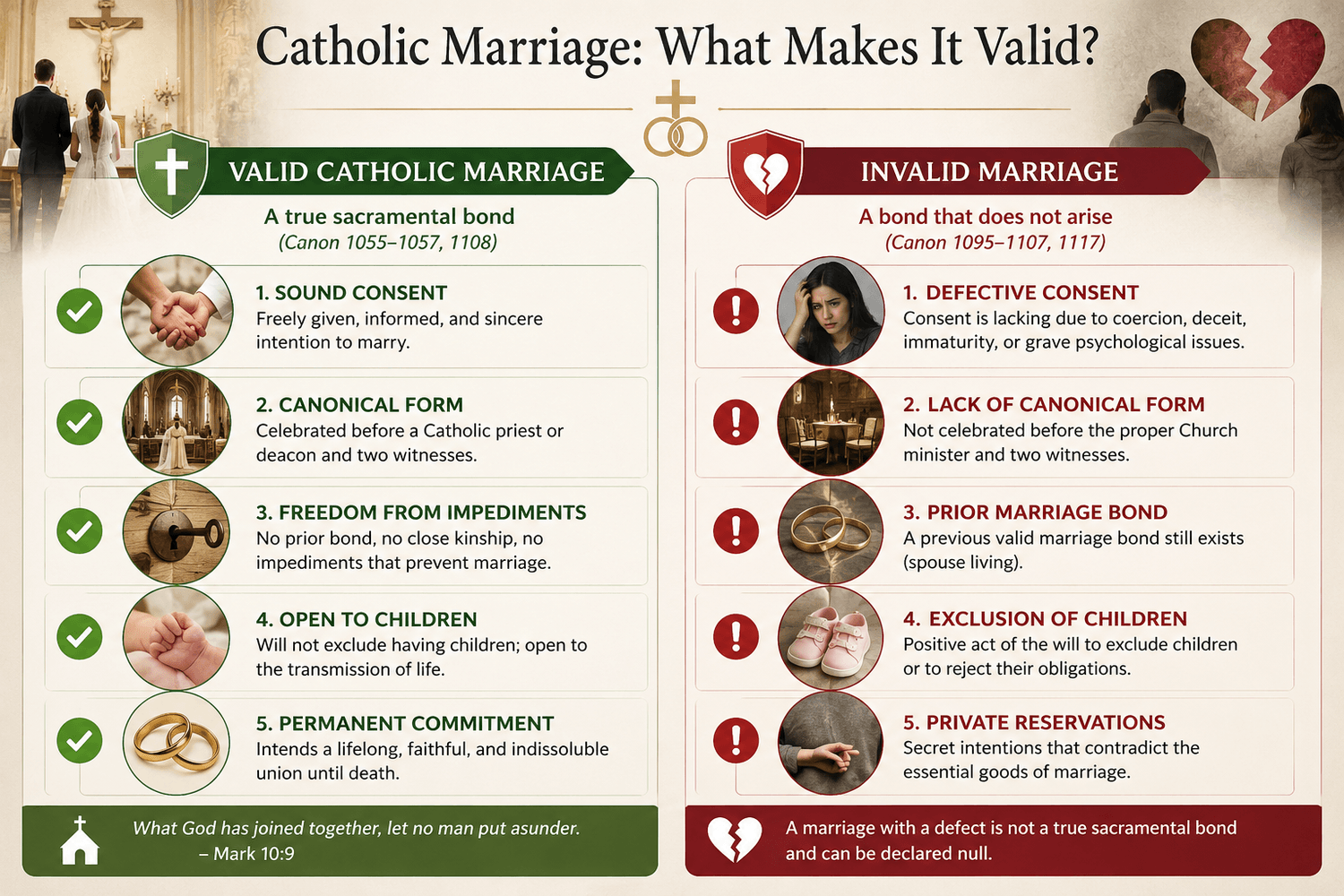
Here is a comparison of what makes a Catholic marriage valid versus invalid:
| Element | Valid | Invalid |
|---|---|---|
| Understanding | You know what marriage is and operate from that knowledge | You can recite Church teaching, but your decisions follow a different understanding |
| Freedom | You could have said no and remained yourself | Pressure or fear made refusal impossible |
| Capacity | You can carry the obligations marriage requires | You sincerely want to marry but lack the internal capacity at this time |
| Intention | Your vows match your will | You privately exclude permanence, fidelity, or openness to children |
| Unity | You and your spouse consent to the same marriage | Your interior understandings diverge without either of you noticing |
| Canonical form | Celebrated before an authorised priest or deacon with two witnesses | Celebrated outside canonical form without a dispensation |
| Impediments | A prior bond or other impediment blocks neither party | One party has a prior marriage bond or other canonical impediment |
What Happens If One Person Excludes Procreation or Uses Contraception in Catholic Marriage?
If a person deliberately excludes openness to procreation at the time of consent, the marriage is invalid (Canon 1101). This is one of the most serious defects a tribunal can find because the procreation and education of children are essential ends of marriage (Canon 1055).
How does the Catholic Church view contraception in relation to marital consent? The Church distinguishes between the intention to exclude children entirely and the use of contraception within a marriage that remains open to life.
If, at the moment of consent, a person intends never to have children, that exclusion invalidates the consent. If a married couple uses contraception at some point in their marriage while remaining fundamentally open to children, that is a moral question but does not necessarily invalidate the marriage bond.
The distinction matters. A couple who use contraception for a season but would welcome a child if one came are not excluding procreation from their consent.
A person who says "I will never have children" at the altar, even while speaking the Church's vows, is excluding an essential element. The first is a failure in living the marriage well. The second is a failure in consenting to it at all.
The Church also teaches that the marital act must remain open to its procreative meaning. This is the teaching behind the Church's prohibition of contraception.
However, the canonical question of validity focuses on the intention at the moment of consent, not on subsequent behaviour.
A tribunal examining consent asks what you intended when you spoke your vows, not what you did five years later.
Practical Guidance: Examining Your Conjugal Love and Consent Before the Wedding
Work through the five pillars one at a time, separately and honestly, with enough runway to act on what you find. Four to five months before the wedding is the sweet spot. Earlier, and the pressure points have not yet emerged. Later, and there is not enough room to address anything that surfaces.
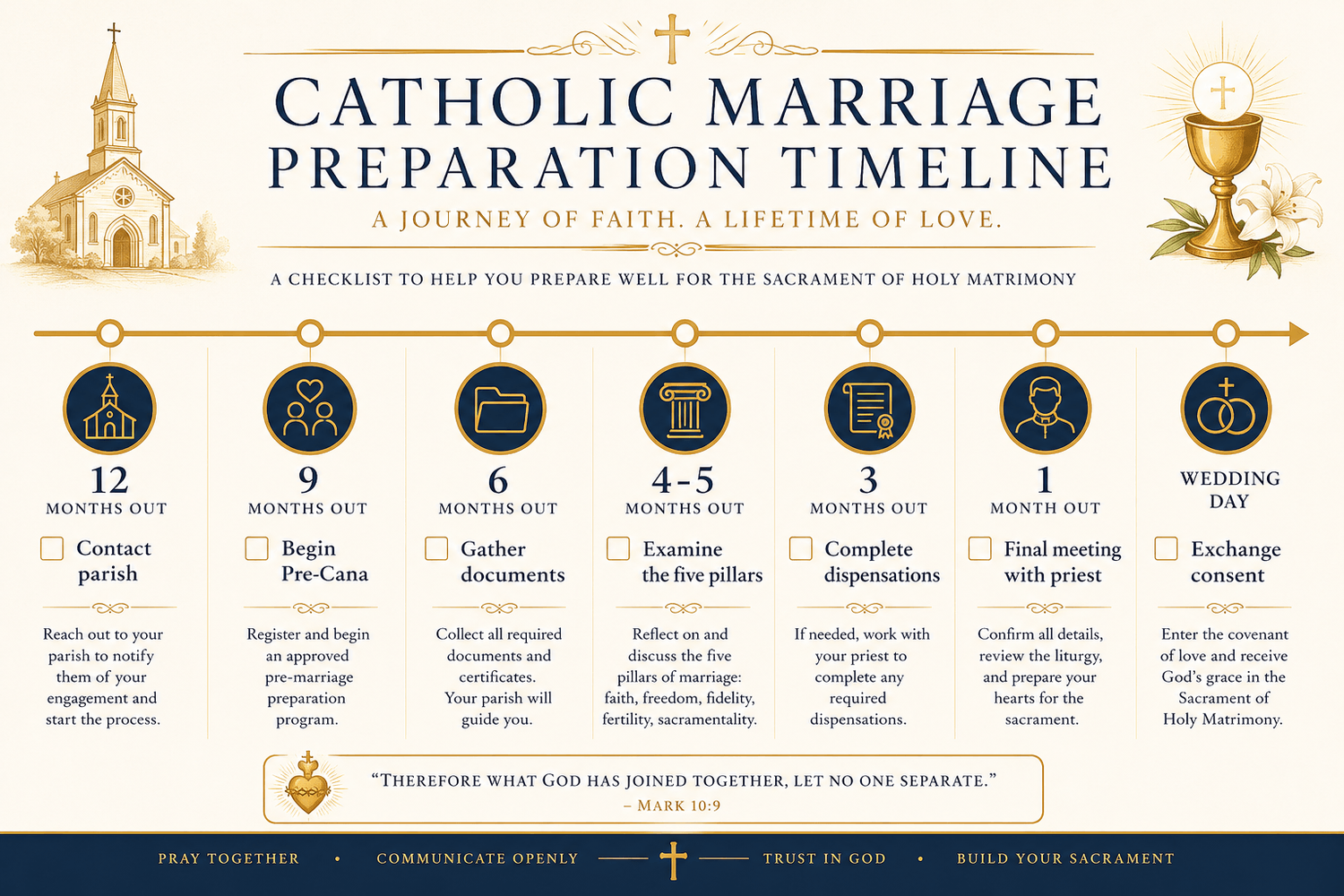
Examine each pillar on your own first. Then compare your answers with your partner. Then bring anything unresolved to your priest. Bring it to him now, while it is a conversation, not years from now when it would be testimony.
For most couples, this examination confirms what they already believed. The yes you are about to give is clearly understood, freely chosen, given by a person ready to carry it, genuinely intended, and matched by the person beside you. That is the common outcome. Certainty you have examined is worth more than certainty you have merely carried.
One honest limit. No website can tell you whether your consent is valid. The tribunal adjudicates. Your priest guides. You examine. What this framework gives you is not a verdict. It is the set of questions you were never asked, delivered while you can still do something with the answers.
Frequently Asked Questions
What makes a Catholic marriage valid?
A valid Catholic marriage requires three things: sound consent freely given, proper canonical form, and freedom from impediments. Consent is the heart, because it is consent that creates the marriage (Canon 1057).
What is matrimonial consent in the Catholic Church?
Matrimonial consent is the act of the will by which a man and a woman irrevocably give and accept each other to establish a marriage (Canon 1057). It is not a feeling or a revisable agreement. It is a single, unconditional act.
Can a Catholic marriage be invalid even if the wedding was done correctly?
Yes. A ceremony can follow every rule and still produce no valid marriage if the consent underneath was defective. A tribunal examines whether genuine consent was given, not whether the wedding was celebrated correctly.
What is the difference between an annulment and a divorce?
A civil divorce ends a marriage the law recognised as existing. A declaration of nullity is a finding that a valid marriage never came into being, because something required for valid consent was missing from the start.
What are the most common grounds for a Catholic annulment?
Many declarations of nullity rest on a defect in consent: incapacity to assume marital obligations (Canon 1095), failure of minimum understanding (Canon 1096), force or grave fear (Canon 1103), or deliberate exclusion of an essential element (Canon 1101).
Does Pre-Cana check whether your consent is valid?
No. Pre-Cana prepares you for married life, covering communication, finances, and the theology of marriage. It is not a canonical examination of your consent.
Can Catholics marry non-Catholics in the Church?
Yes, with the required permission or dispensation. A Catholic marrying a baptised non-Catholic needs permission for a mixed marriage. A Catholic marrying a non-baptised person needs a dispensation from disparity of cult (Canon 1086).
What is convalidation?
Convalidation is the process by which an invalid marriage, typically due to lack of canonical form, is made valid in the Church. It involves addressing the defect and renewing consent.
How long does Catholic marriage preparation take?
Most parishes require six to twelve months of preparation. This includes pre-Cana, meetings with your priest, document gathering, and any needed dispensations.
What documents do you need for a Catholic wedding?
You typically need baptismal certificates issued within the last six months, confirmation certificates, a civil marriage licence, and any needed dispensations or permissions. If either party was previously married, annulment documents or a death certificate are required.
Conclusion
If you take one thing from this, take the difference between two kinds of certainty. There is the certainty you have carried, unexamined, into the wedding.
Moreover, there is the certainty you have tested and found to hold. They feel identical from the inside, right up until the marriage is under real weight. Only one of them was ever actually examined.
You have time to do that examination now. Work through the five pillars with your partner. Bring anything that comes to mind to your priest. Give your consent knowing it is examined rather than merely assumed.
A valid Catholic marriage begins with a yes you have looked at honestly. What would change if you and your partner sat down this week and worked through the five pillars together?
Sources
Code of Canon Law (1983), canons 1055, 1056, 1057, 1060, 1086, 1095, 1096, 1101, 1103, 1124, 1127.
Catechism of the Catholic Church, 1601 to 1666 (The Sacrament of Matrimony), especially 1625 to 1632 on matrimonial consent.
Second Vatican Council, Gaudium et Spes, 47 to 52 (marriage and conjugal love).
Pope Paul VI, Humanae Vitae (the openness of the marital act to life).