What Is the Catholic Marriage Catechumenate?
By Rev. Fr. Michael C. Chime, JCD
Quick Answer: The Catholic Marriage Catechumenate is the Church's model for forming couples toward the sacrament of marriage in phases and stages over time, modelled on the journey adults make toward baptism.
It was set out in the 2022 Vatican document Catechumenal Pathways for Married Life. Formation stretches from childhood, through engagement and the wedding, into the first years of married life.
I have spent twenty years as a judge at the Enugu Interdiocesan Marriage Tribunal, and I can tell you why the Church built this. Every nullity file I read is a preparation story told backwards.
The catechumenate exists to write that story forwards instead.
Key Takeaways:
The marriage catechumenate is a catechumenal model of marriage formation proposed by the Dicastery for Laity, Family and Life in 2022, answering Pope Francis's repeated calls for deeper preparation
The document describes a pre-catechumenal phase of remote preparation, a brief period of reception, and then three stages: proximate preparation, final preparation, and accompaniment in the first years of marriage
It does not abolish Pre-Cana or your parish marriage course; it places the course inside a longer journey of formation and accompaniment
Pope Francis presented the model to the Church's own judges as an antidote against null and fragile marriages, which is a validity argument, not only a pastoral one
Couples already married civilly or by customary rites are not excluded; the model was written with them in mind
What Is the Marriage Catechumenate?
The marriage catechumenate is the Church's plan to prepare couples for the sacrament of marriage the way it prepares adults for baptism.
Formation comes gradually, in stages, inside a community. It continues after the sacrament is celebrated.
A catechumen is an adult preparing for baptism. That preparation is never a single class. It is a journey with rites, teachers, and companions, and it changes the person walking it.
The Church now asks a simple question. If baptism deserves that seriousness, why should marriage receive a weekend?
In June 2022, the Dicastery for Laity, Family and Life published Catechumenal Pathways for Married Life, pastoral guidelines that give this vision its structure.
Pope Francis wrote the preface himself. He asked for a true catechumenate covering the whole sacramental path: preparation, celebration, and the years that follow, especially in moments of crisis.
One line of the document sets its whole spirit. This is not preparation for passing an examination. It is preparation for living.
Why the Church Changed How It Prepares Couples
The Church changed its model of marriage preparation because the old one reached couples too briefly and too late. The tribunals of the Church could measure the cost.
What the Tribunal Files Reveal
I preside over cases that began at an altar. In file after file, the seed of the failure was already present on the wedding day.
An understanding of marriage recited but never owned. A freedom that was never fully real. An intention that quietly excluded what the vows promised.
No one caught it because the era's preparation was not built to catch it. A short marriage course can confirm what a couple can say about marriage. It rarely reaches what they actually carry into consent.
Pope Francis said this plainly to the Church's own judges. In his Address to the Roman Rota in January 2017, he called for marriage preparation to become an integral part of the sacramental process itself, as the catechumenate is to baptism.
He named the purpose without blinking: an antidote against the increase of null or fragile marriage celebrations.
Notice where he said it. Not at a wedding conference, but before the court that judges nullity.
The marriage catechumenate was announced, in part, as a legal remedy.
From Familiaris Consortio to the 2022 Document
The idea predates Pope Francis. In 1981, John Paul II taught in Familiaris Consortio, section 66, that preparation for marriage is a gradual, staged journey: remote, proximate, and immediate. The community then continues to help the couple after the wedding.
Pope Francis pressed the point in Amoris Laetitia, sections 205 to 222. Couples, he observed, often receive formation only after the date is set and the habits are formed.
The catechumenal approach of the 2022 document is the Church acting on forty years of its own diagnosis.
Catechumenal Pathways for Married Life was published in June 2022 by the Dicastery for Laity, Family and Life, under its prefect, Cardinal Kevin Farrell.
The Church gathered in Rome that same month for the World Meeting of Families. The document offers pastoral guidelines, not new law.
Each diocese is invited to tailor the model to its own people, which is why the details you meet in your parish will vary.
The momentum is real. The USCCB now maintains its own marriage catechumenate resources for dioceses.
Bishops from Cincinnati to Westminster have published implementation frameworks.
Gatherings such as the Marriage Catechumenate Summit, hosted by the Witness to Love marriage ministry, bring family ministry leaders together around the work.
The Phases and Stages of the Marriage Catechumenate
The document describes one preparatory phase, one brief phase of welcome, and then a catechumenal phase in three stages.
Here are the stages of the sacramental journey as the Vatican text lays them out, along with what each part asks of you.
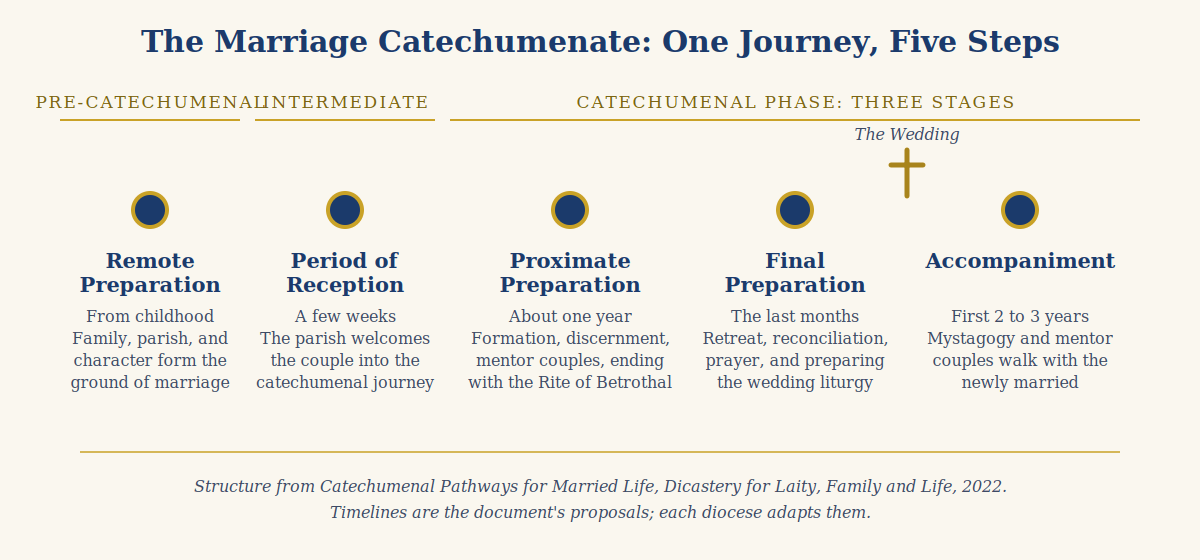
Remote Preparation: The Ground Is Formed Early
Remote preparation is the pre-catechumenal phase that begins in childhood.
The document teaches that the groundwork for a future marriage is laid long before any engagement, in the family, the parish, and the formation of character.
How long does it last? Years, because it is not a program.
It is the slow work of showing young people what faithful love looks like before anyone asks them to promise it.
Why it matters to you: the working idea of marriage you carry today was formed here, whether anyone tended it or not.
The Period of Reception: The Church Welcomes You
When a couple approaches the Church, the document proposes an intermediate phase lasting a few weeks: a period of reception.
The parish welcomes the couple, listens to their story, and marks their entry into the catechumenal journey.
This replaces the old first encounter, which was too often an office appointment about paperwork.
The couple is received as people beginning something sacred, not as applicants opening a file.
Proximate Preparation: About a Year of Formation
Proximate preparation is the first stage of the catechumenal phase proper, and the document envisions about a year.
This is where real formation happens. It brings teaching on the sacrament of marriage and honest dialogue about permanence, fidelity, and children.
It brings discernment of the decision itself, and the company of mentor couples.
This is also where your parish marriage course or Pre-Cana program now lives, as one element among several rather than the whole of preparation.
The stage concludes with the Rite of Betrothal, a blessing that publicly marks the couple's decision to move toward marriage.
Final Preparation and the Wedding
Final preparation is the second stage, running through the last months before the wedding.
Most summaries call it immediate preparation; the document's own name for it is final preparation.
It is deliberately spiritual rather than logistical: a retreat, the sacrament of reconciliation, prayer, and unhurried preparation of the wedding liturgy itself.
The couple arrives at the altar recollected, not exhausted.
Then comes the celebration of the sacrament of matrimony.
Consent is exchanged, and what the whole journey was protecting is finally given.
Accompaniment:The First Years of Married Life
The third stage begins on the wedding day and continues for the first two to three years of marriage.
The newly married are not released. Mentor couples and the whole church community walk with them.
The tradition calls this mystagogy: a deepening entry into the mystery and spirituality of the marriage the couple now lives.
This is the stage the old model never had. In my experience on the bench, the first years are exactly when small fractures either heal in community or widen in isolation.
Marriage Catechumenate vs Pre-Cana and the Marriage Course
The marriage catechumenate does not abolish Pre-Cana or the marriage course. It demotes the course from being the whole of preparation to being one instrument within a longer formation.
A note on names: Pre-Cana is the American term, taken from the wedding feast at Cana. Most of the rest of the English-speaking world simply says marriage course or marriage class.
They name the same thing, and the catechumenate treats them the same way.
| Pre-Cana / Marriage Course | Marriage Catechumenate | |
|---|---|---|
| Duration | A weekend or a few evening sessions | From remote formation through the first 2 to 3 years of marriage |
| Who forms you | A course instructor or presenting team | Priest, parish community, and mentor couples |
| Purpose | Transfer of information about marriage | Formation of the persons consenting, toward conversion |
| Rites and belonging | Ends with a certificate of completion | Marked by rites of welcome and betrothal that bind the couple into the parish |
| Where the course fits | Is the whole of preparation | Becomes one element inside proximate preparation |
Four differences carry the weight.
Duration. A course runs a weekend or a few evening sessions. The catechumenal model of marriage formation runs from before engagement to two or three years after the wedding day.
Who forms you. A course has an instructor. The catechumenate forms you in the context of community: priest, parish, and married couples.
The document treats their lived experience as decisive, especially for couples in complicated situations.
Purpose. A course transfers information, and information matters. But the catechumenate aims at the conversion of the persons who consent.
The document is explicit that every itinerary must include formation, reflection, dialogue, liturgy, community, prayer, and celebration together.
Rites and belonging. A certificate ends a course. The catechumenate is marked by rites, welcome and betrothal among them, that bind the couple into the parish rather than graduating them out of it.
The Six Life Stages: How I Teach This Journey
The Vatican document speaks in phases and stages. On this site, I teach the same journey as six life stages.
That framing is my own way of presenting the document's structure for couples and ministers, not the Vatican's own enumeration.
The two map cleanly onto each other.
| Catechumenal Pathways (2022) | Life Stage on This Site | What It Protects |
|---|---|---|
| Remote preparation | Childhood and Family; Youth Guidance | Capacity for consent (Canon 1095) |
| Reception and proximate preparation | Engagement | Operative understanding of marriage (Canon 1096) |
| Final preparation | Marriage Preparation | Freedom and true intention at consent |
| The celebration of marriage | The Wedding | Consent itself, which makes the marriage (Canon 1057) |
| Accompaniment, first years | Early Mystagogy | Unity and fidelity as they are first lived |
| Married couples as agents of this care | Marriage Mentoring | The next generation of consent |
Childhood and Family, then Youth Guidance, carry remote preparation: the years in which the ground of marriage is formed.
Engagement carries the period of reception and proximate preparation, the year of real formation and discernment.
Marriage Preparation carries final preparation, the recollected months before the altar.
Early Mystagogy is accompaniment: the first years, lived with help.
And Marriage Mentoring is where the journey turns outward, because the document names married couples themselves as primary agents of this pastoral care.
The couple who was accompanied becomes the couple who accompanies.
That last turn is the genius of the catechumenate model.
A catechumenate that only receives is a program. A catechumenate that sends is a culture.
The Catechumenate and Valid Consent: The Five Pillars Connection
Here is what no formation brochure will tell you, and what twenty years of tribunal work makes impossible for me to miss.
Each phase of the marriage catechumenate shores up one element of the consent required by canon law.
Canon 1057 teaches that consent makes marriage. Nothing else can supply for it. So a model of preparation is ultimately judged by one question: does it form consent that will hold?
Remote preparation builds capacity, the psychological and human maturity Canon 1095 presumes a person brings to consent.
Proximate preparation moves a couple's understanding of marriage from notional to operative.
Recited answers become truths that actually govern their choices. This is the minimum knowledge Canon 1096 requires, made real rather than merely stated.
That distinction between notional and operative understanding is the heart of my forthcoming book.
Final preparation, with its retreat and its honest pre-nuptial conversations, tests freedom and intention while there is still time to act on what is found.
And accompaniment protects the unity and fidelity that were promised, in the years when they are first tested.
I meet consent after it has failed. The catechumenate is the Church forming consent before it is given.
If you want to see exactly what your consent must contain, my pillar guide on the five pillars of matrimonial consent sets out each element in full.
What If You Are Already Married Civilly or by Custom?
Couples who married civilly, or by customary rites, and who now seek the sacrament are not shut out of the catechumenate.
The document was written with you specifically in view, and the Church's posture toward you is accompaniment, not condemnation.
Around the world, many couples live in the space between a civil or traditional marriage and a church wedding, often for years.
Many cultures, including African ones, have long practised marriage as a staged journey involving families and community.
The idea of marrying in stages is not foreign. What the catechumenate adds is formation and grace at each stage.
The path into the sacrament from a civil or customary union is called convalidation. It is not a blessing added to the old ceremony. It is a new act of consent, a real marriage in the eyes of the Church, and it deserves real preparation.
That is why I treat the convalidation of a civil marriage as a separate subject.
If you are cohabiting, expect your priest to raise it honestly and gently. The document asks pastors to walk with couples gradually, from where they are to the fullness of the sacrament.
What This Means for You
For Engaged Couples
Contact your parish before you fix anything else. In dioceses implementing the catechumenate, preparation may run eight to twelve months. The venues can wait for the sacrament rather than the other way round.
Ask what your diocese has in place. How long does preparation run? Are mentor couple sessions offered, and is there a betrothal blessing? Which course or inventory is used, and is a natural family planning course included?
And as you prepare for marriage, begin your own examination early. My free Marriage Readiness Diagnostic is built from the tribunal side of this subject. It helps you see your foundation while there is still time to strengthen it.
For Priests and Marriage Ministers
Canon 1063 already obliges us to provide preparation for the sacrament personally and within the community. The catechumenal model is a structure for doing what the law has always asked.
The document is deliberately adaptable. It expects each diocese and parish to tailor the pathway to its own conditions.
Two implementation decisions matter most, in my judgment. The first is the recruitment and formation of mentor couples, since the model stands or falls on them.
The second is the honest placement of your existing marriage course inside proximate preparation rather than beside it.
The USCCB's published frameworks and workbook are a serviceable starting point for any parish team, wherever you are.
Ministry to marriage and family life at this depth is also evangelisation. For many couples, the catechumenal pathway will be their first adult encounter with the Gospel, and their first experience of discipleship inside a parish that knows their names.
Canon 1063 already obliges us to provide preparation for the sacrament personally and within the community. The catechumenal model is a structure for doing what the law has always asked.
The document is deliberately adaptable. It expects each diocese and parish to tailor the pathway to its own conditions.
Two implementation decisions matter most, in my judgment. The first is the recruitment and formation of mentor couples, since the model stands or falls on them.
The second is the honest placement of your existing marriage course inside proximate preparation rather than beside it.
The USCCB's published frameworks and workbook are a serviceable starting point for any parish team, wherever you are.
Ministry to marriage and family life at this depth is also evangelisation. For many couples, the catechumenal pathway will be their first adult encounter with the Gospel, and their first experience of discipleship inside a parish that knows their names.
Conclusion
The Catholic Marriage Catechumenate is the Church's decision that marriage deserves the seriousness it has always given to baptism, because consent deserves that seriousness.
I have read too many files in which no one asked the deep questions until a tribunal had to. This model asks them early, in community, with grace attached, which is precisely where they belong.
If you are preparing for marriage, take the first step this week. Contact your parish and ask how preparation works in your diocese. Enter it as a marriage formation, not a clearance for a wedding.
And if you want to walk into that preparation with your eyes open, take the Marriage Readiness Diagnostic.
Then join the waitlist for my book, BEFORE YOU SAY 'I DO' AT THE ALTAR.
It takes you inside the questions a marriage tribunal asks, while there is still time to act on the answers.
Frequently Asked Questions
Is the marriage catechumenate mandatory for Catholic couples?
Not universally. Catechumenal Pathways for Married Life is pastoral guidance, not a new law. Each diocese decides how to implement it, and some have already made longer preparation binding locally.
Marriage preparation itself, in some form, is required everywhere under Canon 1063, so ask your own parish what applies to you.
How long does the marriage catechumenate take?
The document envisions about a year of proximate preparation, a few months of final preparation, and accompaniment through the first two to three years of marriage.
In dioceses implementing the model, some now ask for eight to twelve months of preparation before the wedding. The exact timeline is set by your diocese, so ask early.
Does the marriage catechumenate replace Pre-Cana or the marriage course?
No. Your Pre-Cana program or marriage course is one element within the proximate stage of a longer journey, rather than the whole of preparation.
The catechumenate adds what a course alone cannot supply: time, community, mentor couples, and formation that continues after the wedding.
What is the Rite of Betrothal in the Catholic Church?
The Rite of Betrothal is a blessing that publicly marks a couple's decision to move toward marriage.
In the catechumenal model, it concludes proximate preparation. It is an ancient practice the Church is reviving.
It is not a wedding. Canon 1062 states plainly that a promise of marriage creates neither a marriage bond nor an obligation to wed.
Can we enter the marriage catechumenate if we already live together?
Yes. Cohabitation is not an impediment to marriage, and the document explicitly asks pastors to accompany cohabiting couples gradually rather than turn them away.
Expect the subject to be discussed honestly during your preparation, because the aim is to make sure your consent is a free and deliberate choice.
Related reading: Catholic Marriage Preparation Beyond Pre-Cana. Your Home Is a Domestic Church.
FORTHCOMING BOOK
BEFORE YOU SAY 'I DO' AT THE ALTAR
My forthcoming book takes you inside the questions a marriage tribunal asks, so you can examine your own consent while there is still time to act on what you find. Be the first to know when it is released.
Notify Me When the Book Is Out